Most floral arrangements today end up looking like a tangle of stems and petals, a last-minute afterthought on a kitchen counter. Yet place the same blooms in a vessel of pure, hand-cut crystal, and something shifts-not just in appearance, but in presence. The light bends, the colors deepen, and suddenly you’re not just displaying flowers, you’re staging a quiet moment of beauty. The difference isn’t in the florals. It’s in the clarity of vision-and the vessel.
Preparing your crystal vessel for a masterpiece
The importance of pristine glass
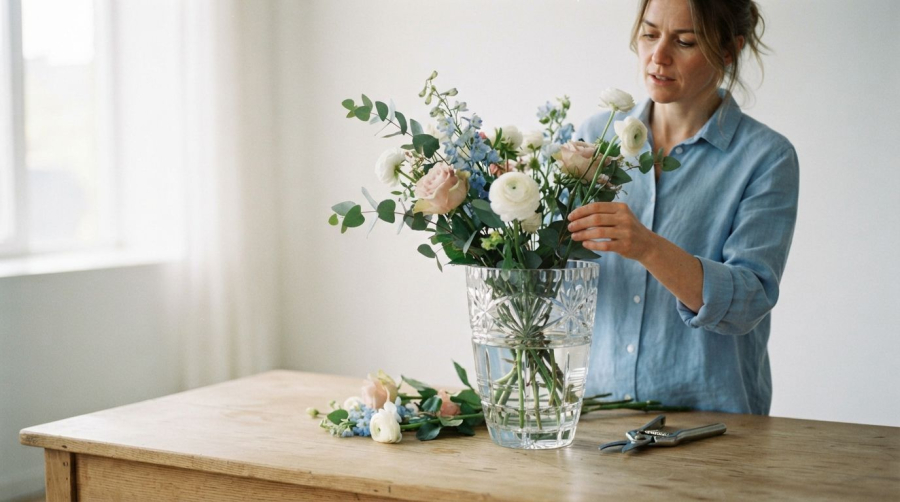
A flawless surface isn’t just about elegance-it’s functional. Any smudge or residue on crystal distorts the path of light, muting the natural radiance of stems and petals beneath. Before placing a single bloom, clean the interior with a soft, lint-free cloth, avoiding abrasive cleaners that could scratch thehand-cut brilliance. Crystal, especially when mouth-blown, carries a sensitivity to touch; fingerprints linger. Treat it as you would a fine lens. A stunning floral arrangement truly breathes life into a room when displayed in a large crystal vase.
Water quality and temperature
Use lukewarm water-not cold, not hot-to encourage immediate uptake through the stem. Avoid hard tap water if possible, as mineral deposits can leave faint rings over time, dulling the luminous transparency that makes crystal so distinctive. If your tap water is highly mineralized, consider using filtered water. Add floral preservative sparingly, choosing a clear formula to prevent cloudiness. Some commercial mixes can leave a residue or film, which defeats the purpose of showcasing purity.
Establishing the grid for stability
Unlike opaque vases, crystal reveals everything-including the mechanics beneath. To avoid visible stems leaning or collapsing, create an invisible support system. Use clear florist tape stretched in a crisscross pattern across the opening. For deeper vases, consider a reusable glass frog or a stainless steel kenzan (pin frog). These preserve the clean look while offering secure anchoring. The goal is structural integrity that disappears into the background-what matters is the harmony above the rim.
Essential techniques for floral design
Proper stem preparation
Cut each stem at a 45-degree angle-this increases the surface area for water absorption and prevents the base from sealing against the vase floor. For best results, cut underwater to avoid air bubbles entering the vascular system, which can block hydration. Use sharp, clean shears; a crushed stem invites early wilting. Stripping leaves below the waterline is non-negotiable-submerged foliage decomposes, feeding bacteria that shorten vase life.
Building the foundation with foliage
Start with greenery to create a supportive matrix. This “green architecture” acts as a scaffold. Use flexible stems like eucalyptus, ruscus, or lemon leaf to weave a stable base. Place them at varying heights and angles to fill space naturally. This layer does double duty: it hides tape or mechanics and establishes volume before introducing color. Think of it as laying the groundwork for a sculpture-structure before statement.
- Begin with longer, arching stems around the perimeter
- Layer in shorter pieces to build density at the center
- Rotate the vase as you work to ensure even distribution
Balancing height and volume
The rule of optical proportions
As a general guideline, the total height of the arrangement should be one and a half to two times the height of the vase. In a tall crystal vase, this isn’t just aesthetic-it’s optical. Too short, and the arrangement looks stunted. Too tall, and it risks toppling, especially if weighted at the top. But more than height, consider visual balance. Crystal amplifies whatever is inside. A single stem of white calla lily can command attention more than a cluster in an opaque vessel. The submerged portion of stems should also contribute to the composition-straight, clean lines enhance the sense of order.
Creating a focal point
Choose two or three dominant flowers and group them slightly off-center. This creates a natural point of interest without rigidity. In crystal, where every detail is visible, symmetry can feel sterile. Instead, aim for asymmetrical balance. Position your largest bloom slightly forward, supported by companions of similar scale. Surround it with softer textures and trailing elements to guide the eye back toward the center. The transparency of the vase means the back view matters just as much as the front-design in the round, not as a flat tableau.
Choosing complementary flower types and colors
Harmonizing with seasonal blooms
Spring favors peonies, ranunculus, and tulips-their soft curves and pastel tones catch the light like watercolor. Summer calls for bold textures: sunflowers, dahlias, and zinnias, which hold their form and color even under strong daylight. Autumn arrangements gain depth with deep burgundies and ochres, using chrysanthemums or hypericum berries. Winter is the season of contrast: white amaryllis, deep red roses, and frosted branches play beautifully against clear crystal, creating a festive yet refined statement.
The role of light and transparency
Crystal doesn’t just hold flowers-it interacts with them. The refractive quality of lead crystal bends light, casting faint rainbows when properly angled. This means placement matters. A vase near a window captures morning or afternoon sun, while one on a well-lit console can glow at night. Colors intensify: red blooms deepen, whites appear brighter, and translucent petals like those of lisianthus or nigella take on an ethereal quality. It’s not just arrangement. It’s floral architecture shaped by light.
| Style | Best Flower Pairing | Visual Effect in Crystal |
|---|---|---|
| Romantic | Roses, peonies, ranunculus | Soft diffusion of color, velvety depth |
| Modern | Calla lilies, monstera leaves, anthurium | Clean lines, dramatic shadows |
| Wild | Wildflowers, eucalyptus, scabiosa | Organic movement, playful contrasts |
Final notes and care
Even the most carefully assembled arrangement loses vitality without maintenance. Trim stems every few days and replace water with fresh, filtered liquid. Dust the exterior of the vase gently-avoid submerging hand-cut crystal in hot water, as thermal shock can occur. With proper care, a single arrangement can remain elegant for over a week. And when it fades? That’s not an ending. It’s an invitation to begin again, with new blooms and a renewed sense of balance.
What you gain isn’t just beauty-it’s rhythm. The ritual of tending to flowers in crystal becomes part of daily life, a quiet pause in an otherwise hurried world. It’s not about perfection. It’s about presence. And in that, even a simple bouquet can become something enduring.
- Refresh water every 2-3 days to prolong bloom life
- Keep arrangements out of direct sunlight to prevent overheating
- Store crystal vases upright when not in use to avoid chipping
